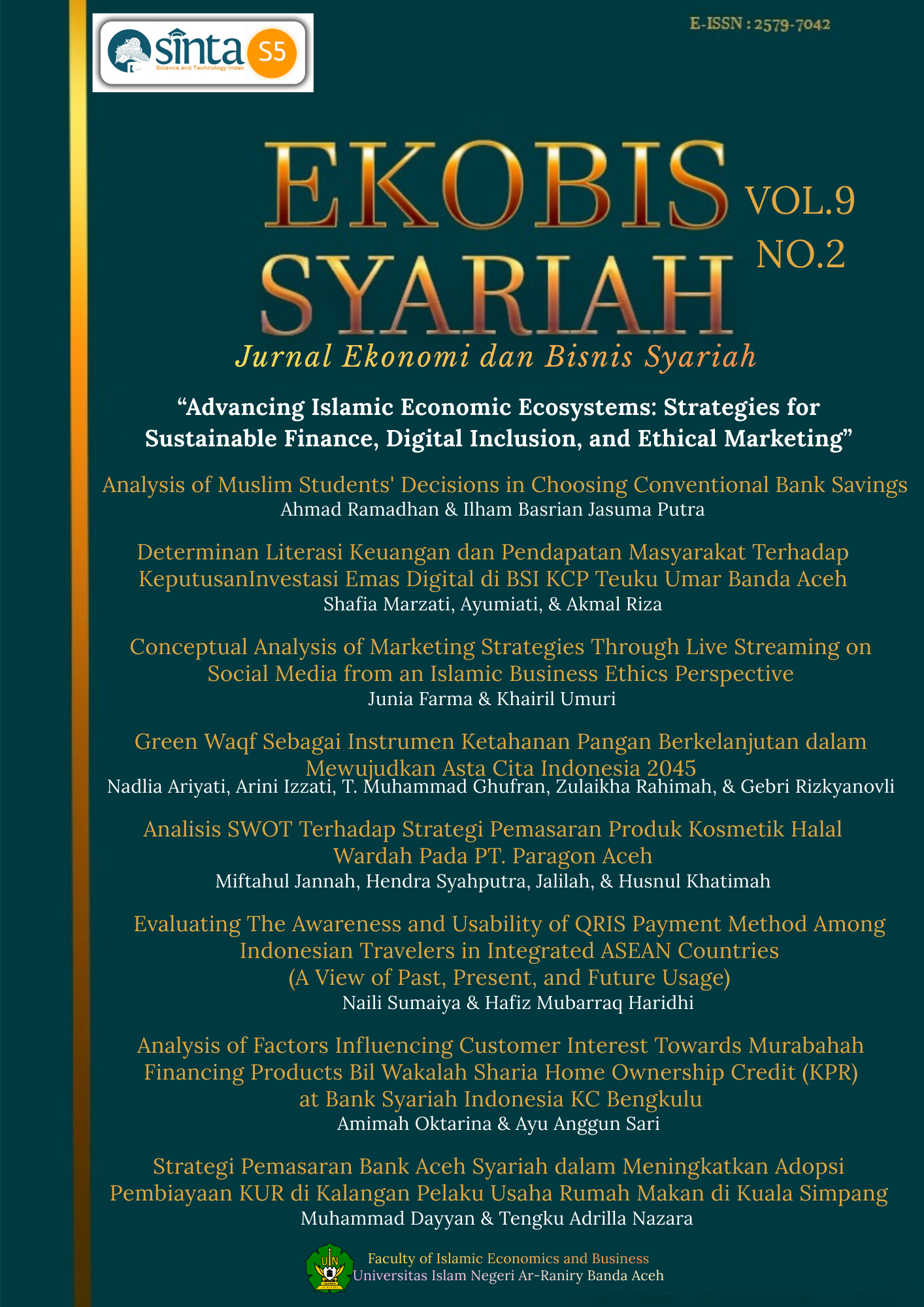
Conceptual Analysis of Marketing Strategies Through Live Streaming on Social Media from an Islamic Business Ethics Perspective
DOI:
https://doi.org/10.22373/jexjzw06Abstract
The advancement of digital technology has transformed the global marketing landscape, particularly through the use of live streaming as an interactive, real-time promotional strategy. In Indonesia, this trend has grown rapidly alongside the widespread adoption of social media and smartphones. Despite its effectiveness in boosting consumer engagement and sales conversion, live streaming marketing often raises ethical concerns, especially within the framework of Islamic business ethics. This article conceptually analyzes live streaming-based marketing strategies on social media through the lens of Islamic business ethics. The study identifies ethical violations such as overclaiming, non-transparent endorsements, and emotional manipulation, which conflict with Sharia principles like sidq (honesty), ‘adl (justice), and amanah (trustworthiness). Through a literature review, it is found that most businesses have yet to integrate Islamic ethical values into their digital strategies. Islamic business ethics emphasize not only economic efficiency but also moral and spiritual responsibility toward consumers and society. This article recommends integrating Islamic values into digital marketing strategies to ensure business sustainability and divine blessings (barakah). The study contributes to scholarly literature on marketing and Islamic business ethics while providing a conceptual foundation for future research on technology-driven promotions aligned with Sharia principles.
Downloads
Published
Issue
Section
License
Copyright (c) 2025 Junia Farma, Khairil Umuri

This work is licensed under a Creative Commons Attribution-ShareAlike 4.0 International License.
EKOBIS allows the author(s) to hold the copyright and to retain the publishing rights without restrictions. Authors who publish with this journal agree to the following terms:
- Authors retain copyright and grant the journal right of first publication with the work simultaneously licensed under a Creative Commons Attribution License (CC-BY-SA 4.0) that allows others to EKOBIS the work with an acknowledgment of the work's authorship and initial publication in this journal.
- Authors are able to enter into separate, additional contractual arrangements for the non-exclusive distribution of the journal's published version of the work (e.g., post it to an institutional repository or publish it in a book), with an acknowledgment of its initial publication in this journal.
- Authors are permitted and encouraged to post their work online (e.g., in institutional repositories or on their website) prior to and during the submission process, as it can lead to productive exchanges, as well as earlier and greater citation of published work